This a continuation of my cycling journey through Italy, powered by a hundred meals, fifty espressos and twenty gelatos.
Ortobello
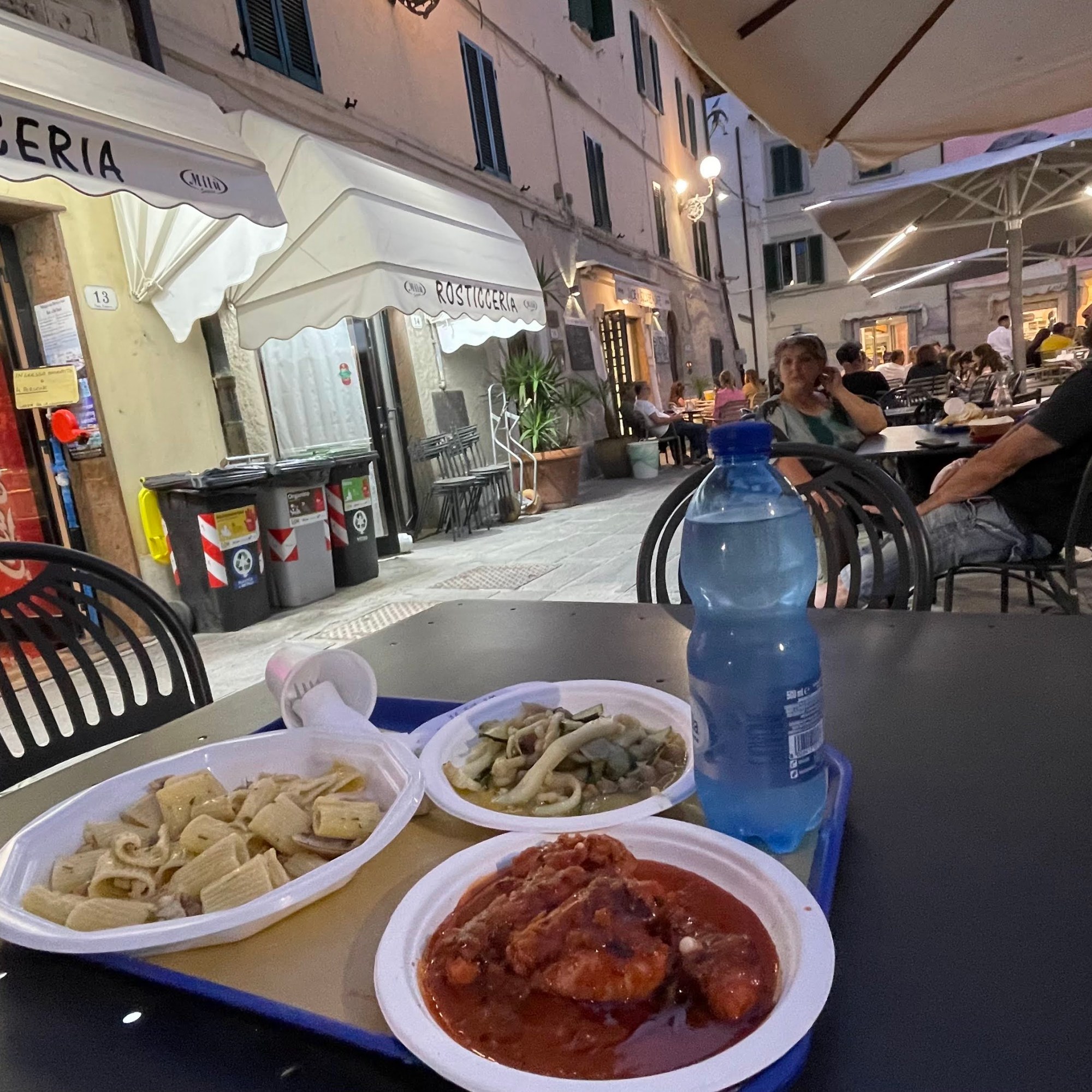
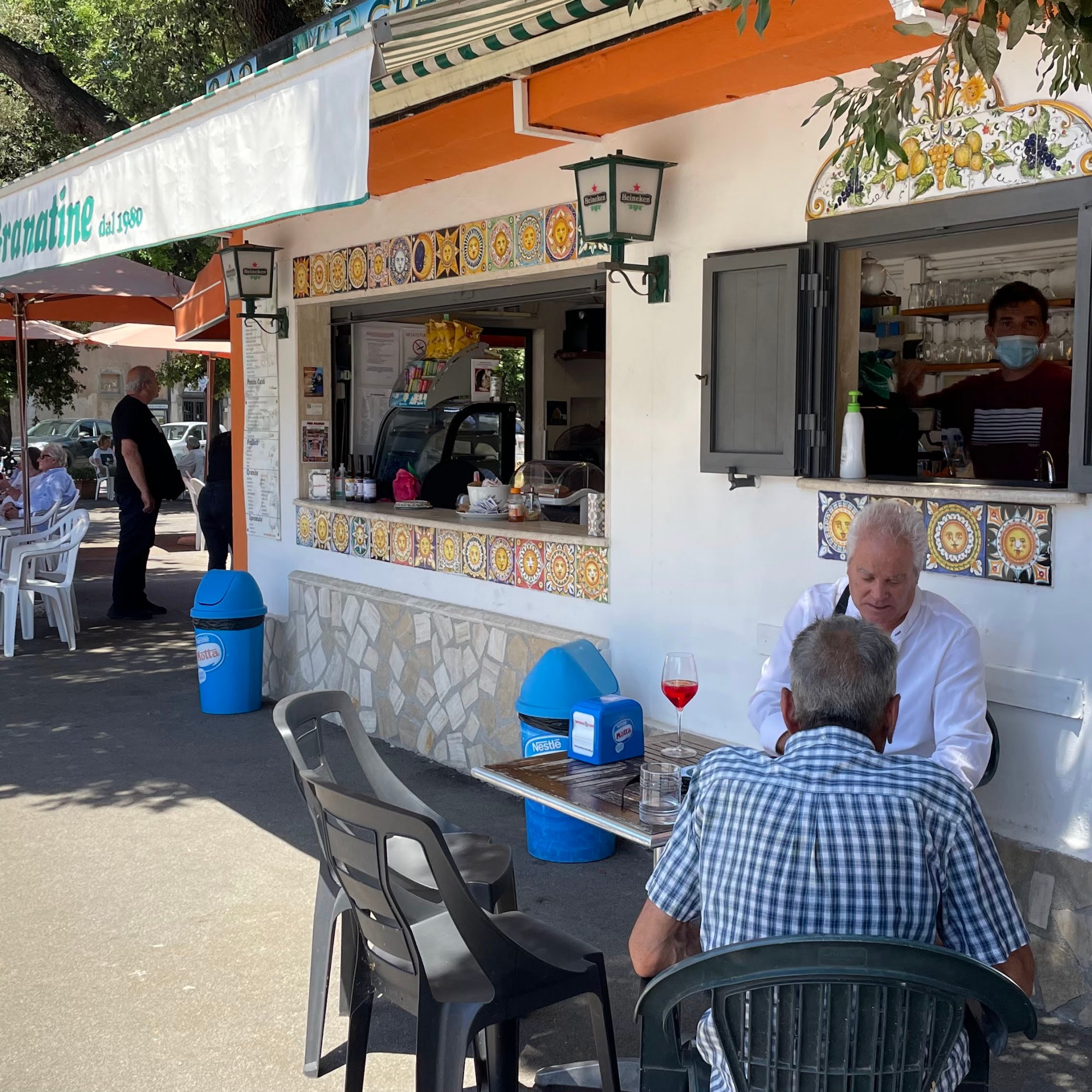
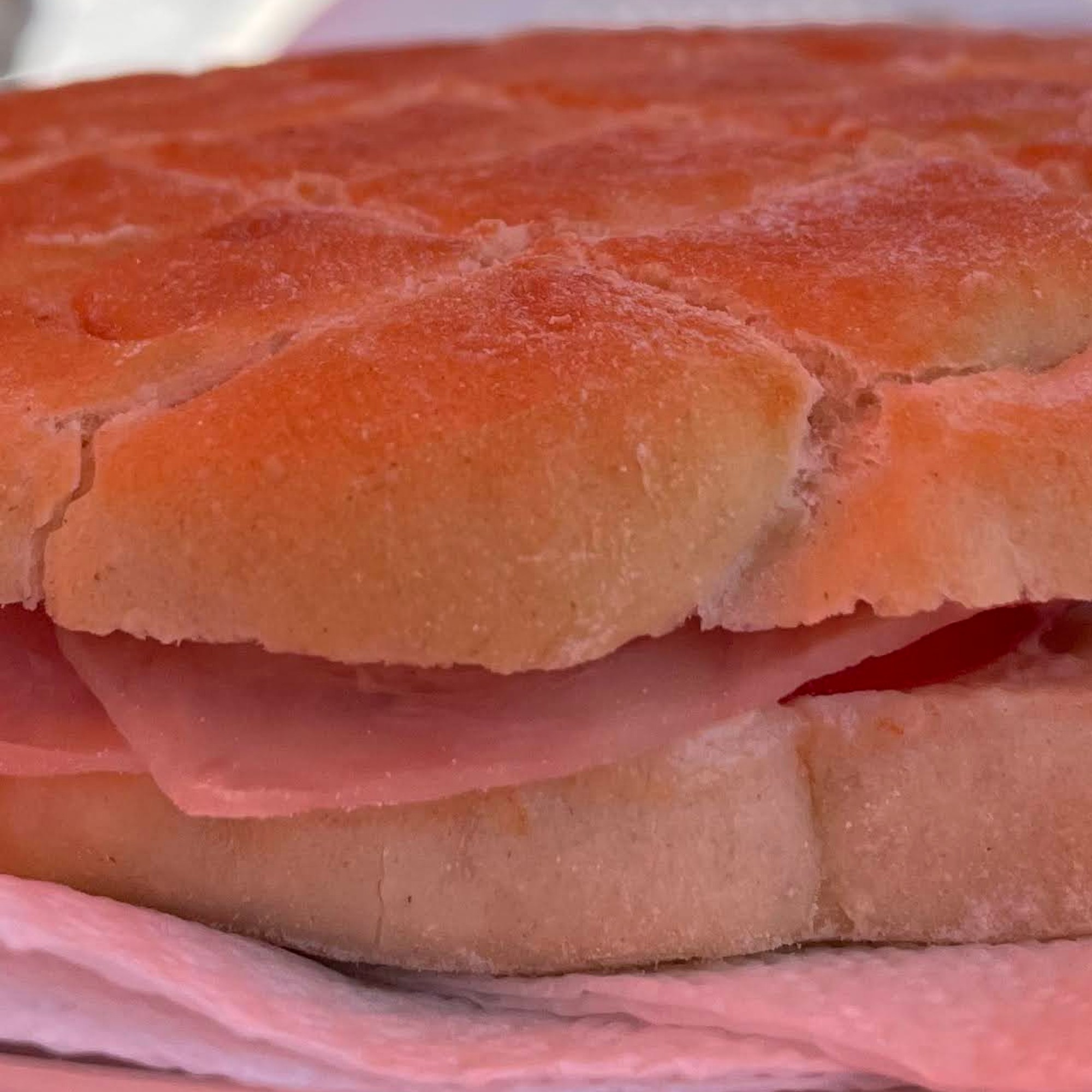
With my trusty bicycle I headed down from the hills of Tuscany to the coastal town of Orbetello, still in Tuscany, thinking that I’d be able to follow the coastline to Rome without any more climbing. That turned out to be a fool’s errand; all the roads that led to Rome invovled climbing back up the hills or braving an expressway without a shoulder. While debating all this Rosticceria Milù, a laid back self-service catch-of-the-day kind of place provided my first encounter with polpo the octopus, something I would repeat frequently over the next few weeks. A laid back local cafe fed me a super-simple but very satisfying panino with proscuitto cotto (cooked ham). For some reason I had eaten meals rather than sandwiches till now; it took a small seaside town to fill the gap.
Finally me and my bicycle caught a train the next morning. If you add up all the negronis in the waiting room the train journey took longer than the bicycle would have taken, landing me into Rome just in time for a late lunch.
Rome
The province of Lazio, accounting for half the population is the glorious city of Rome, capital of empires and religions and (more importantly for me) one of the greatest destinations for Italian food. I quickly learned that this was incorrect; Rome is the greatest destination for Roman food, quite distinct from other parts of Italy. Pizza here is Roman pizza, pasta here is Roman pasta and so on. Food from elsewhere is present, but like a distant-cousin kind of way.
Not that I was bothered with all this theory at lunchtime. I walked into a nearby cafe, al fresco under an umbrella even in the height of summer, and ordered what I had been told TV shows was one of the big four of Roman pastas – Amatriciana – a delicious concoction of spaghetti, pecorino and tomato touched up with guanciale.
Soupy Pasta
I must mention at this point that I’ve had copious quantities of pasta in my life, mainly in the “continental” restaurants of my youth and it has always come with enough sauce to call it a gravy and mop up with a spoon or at least a piece of bread. Italy, so far, had not lived up to this saucy expectation and insisted on feeding me pasta that, while spectacularly tasty, had only the merest hint of the liquid about it. Modena, Bologna, Tuscany had all conspired to smash my childhood memories to bits. Not so in Rome; here there was sauce. While not achieving true Indian gravy status, there was nevertheless an actual distinct fluid sitting around the pasta that begged for a swipe with a finger when all was done. This was to be repeated in all my Roman pasta meals.
As usual, the waiter spoke Bengali and was happy to chat a bit. Since it was a late lunch, he had also started eating – rigatoni al oglio, which is just pasta with olive oil. Dressed up with a sprinkle of cheese and sometimes a touch of pepper (again, no sauce), Italian simplicity on full display, the small sample I got from my new waiter friend made me seriously consider a second lunch. I noticed in subsequent days worker after worker sitting with that al oglio – true delicious poor-man fast food. I later realised this combination of pasta and olive oil was the one universal dish in Italy, available everywhere I went.
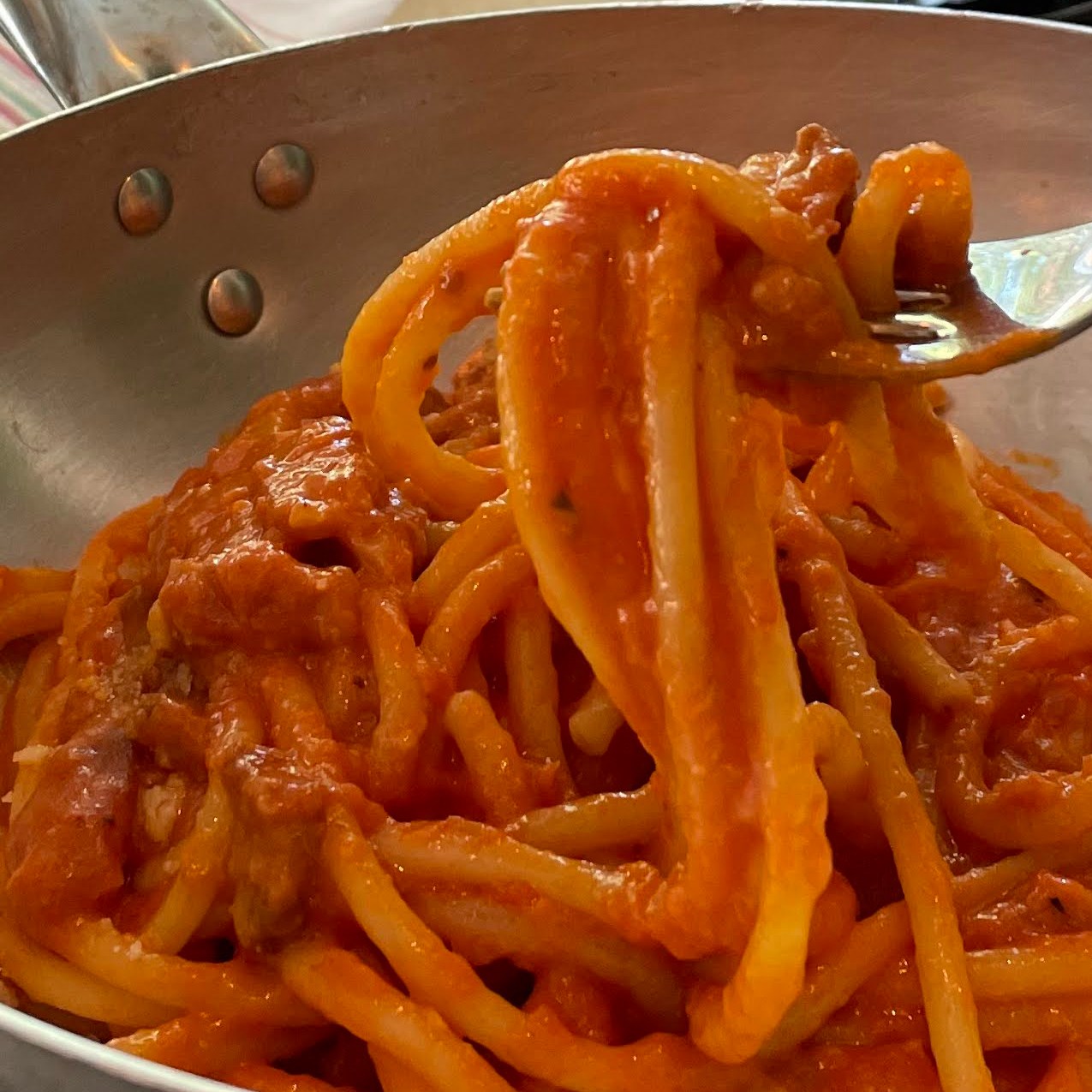
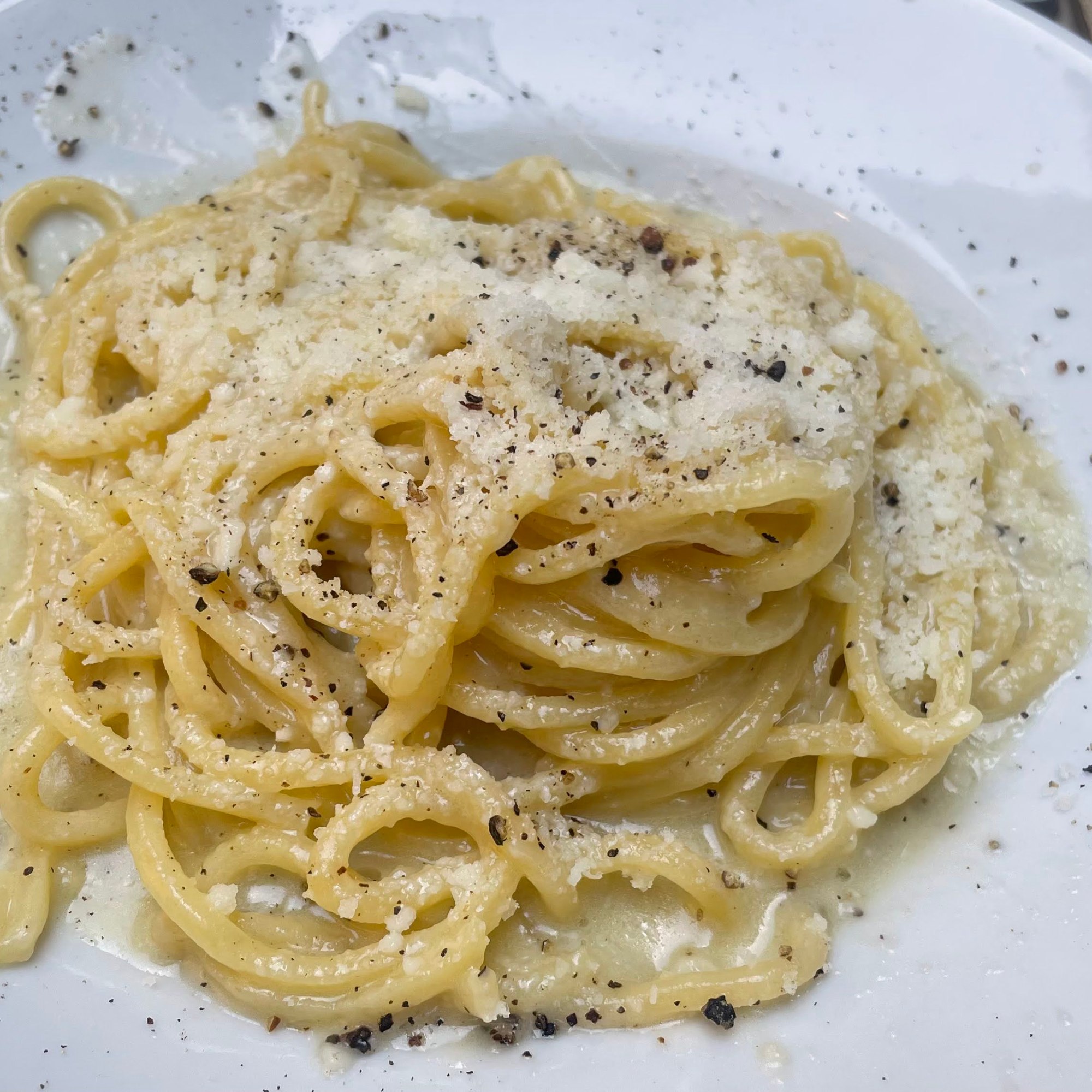
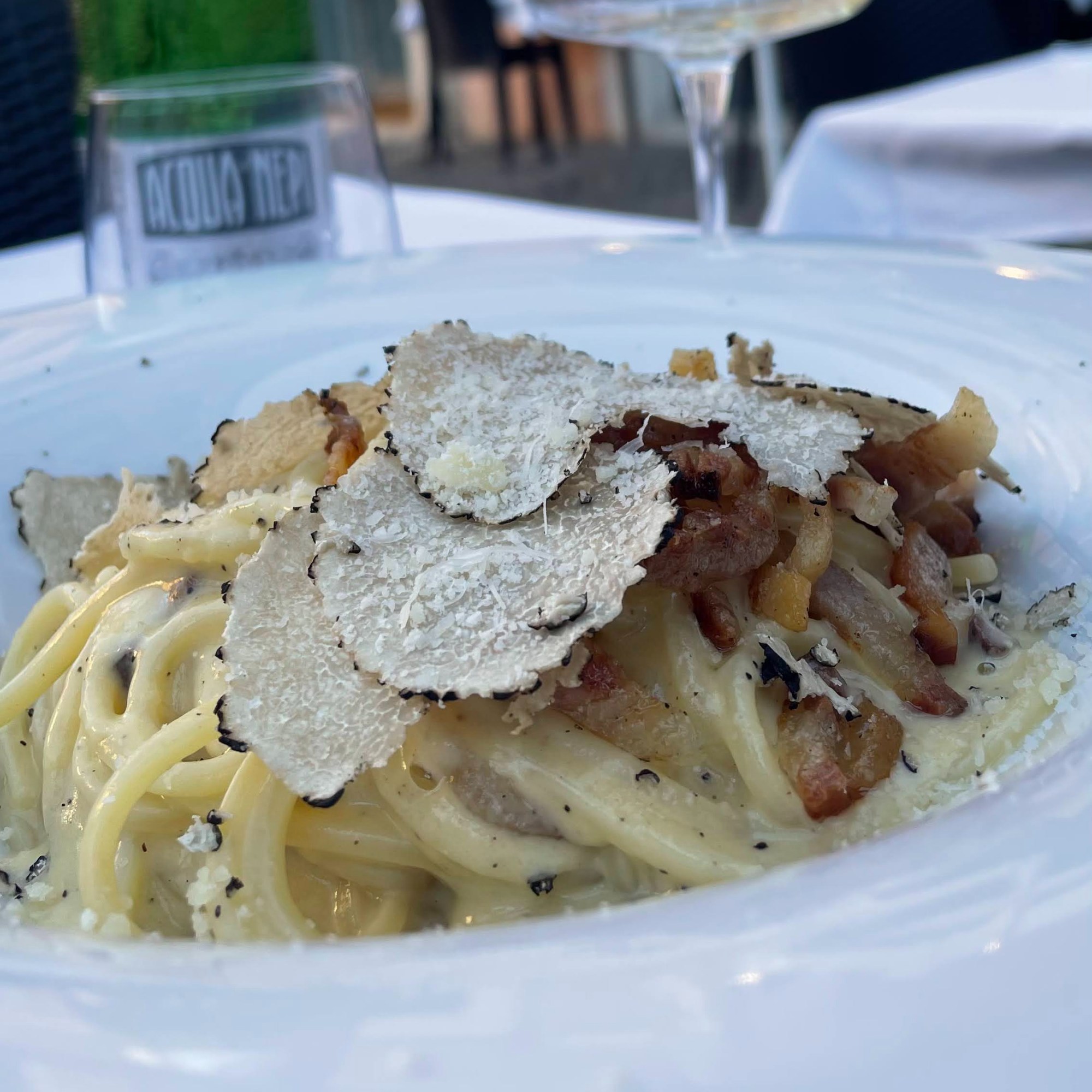
Amatriciana is one of the four great pasta dishes of Rome, the others being Cacio e pepe, Carbonara and Gricia usually served with either rigatoni, spaghetti or a new name – tonarelli. Other shapes like bucatini or linguini also appear on menus but the restaurants seem to insist that these are the “original” choices. The pastas are simple, all with a base of starchy pasta water and pecorino cheese. Cacio pepe adds pepper, carbonara adds egg and guanciale, amatriciana adds tomato and guanciale while gricia adds guanciale and pepper; all this may sound simple, but the results are almost universally astounding. My personal favourite was the truffle-shaved carbonara that Evo Hosteria fed me for a dinner but my most frequent requests lay with the ultra-simple cacio e pepe. Disappointingly, no Fettucine Alfredo in sight except at the restaurant that invented it (where I was unable to secure a table). I also never got around to trying Gricia.
Imagine that. The greatest dishes of Rome have three or four ingredients and only involve boiling, about the same effort as a cheese maggi.
On a side note the pasta everywhere in Italy has more bite than al dente in India. It’s not just firm, its actually chewy – initially a put-off till you get used to it. I don’t know if its better or worse; just the way it is. Only lasagna, I noticed, was as soft as expected.
Panned Pizza
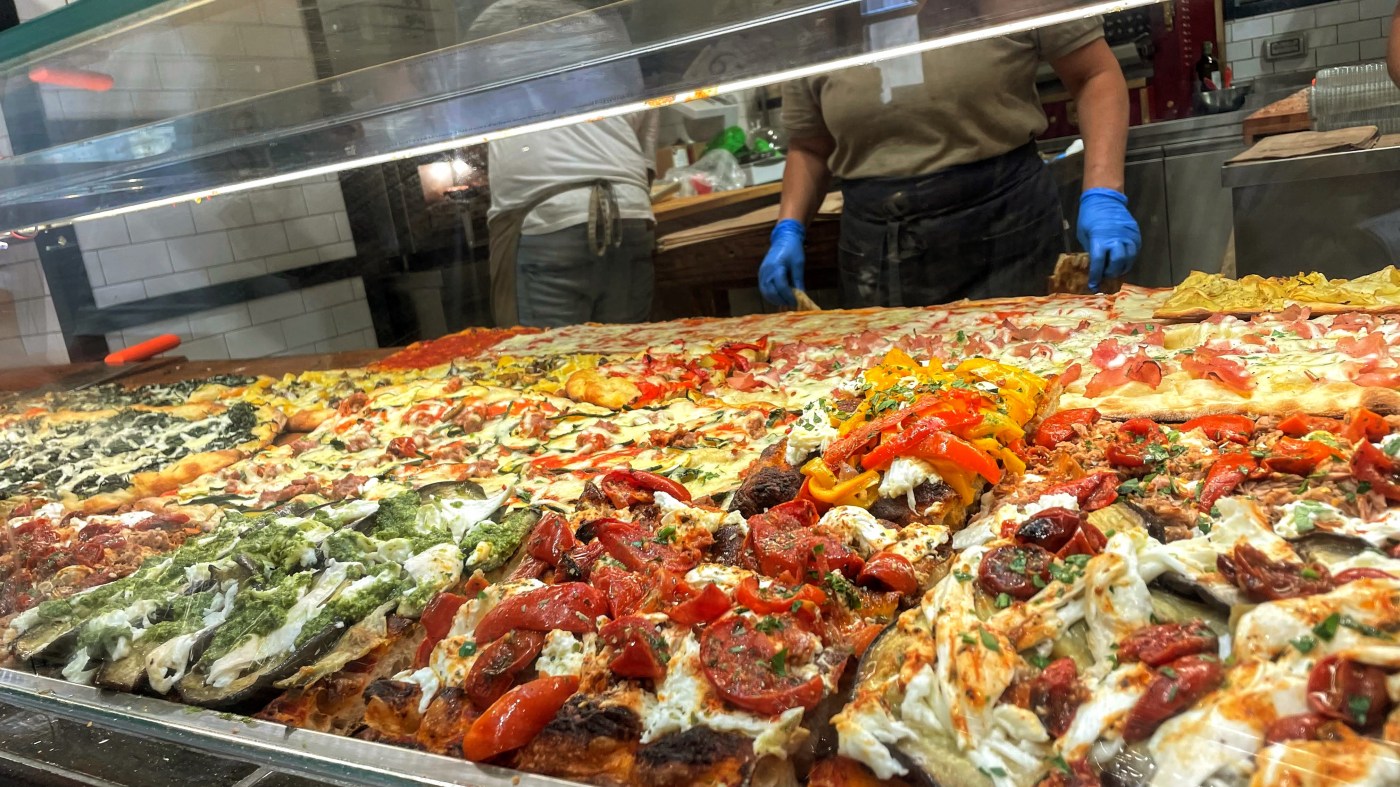
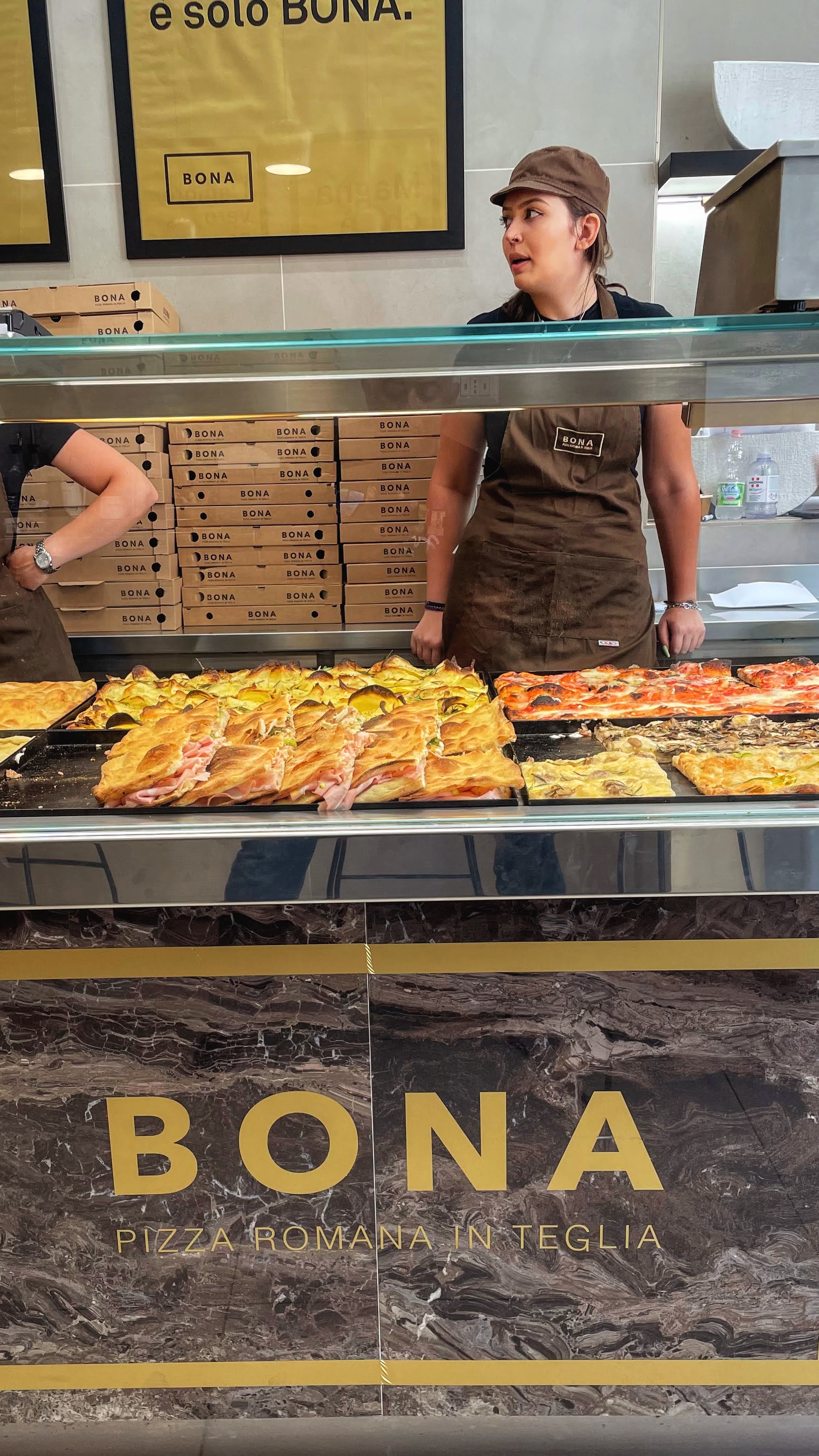
The next big thing in Rome is the pizza but it is unlike pizza anywhere else in the world (or even elsewhere in Italy). Officially called pizza romana in teglia, It’s not round, not served whole, not with a mozarella-tomato base and not served hot straight from the oven. Indeed, if they did not call it pizza you (the ignorant outsider) would not even think of it as pizza – it looks, if anything, like an open faced deli sandwich.
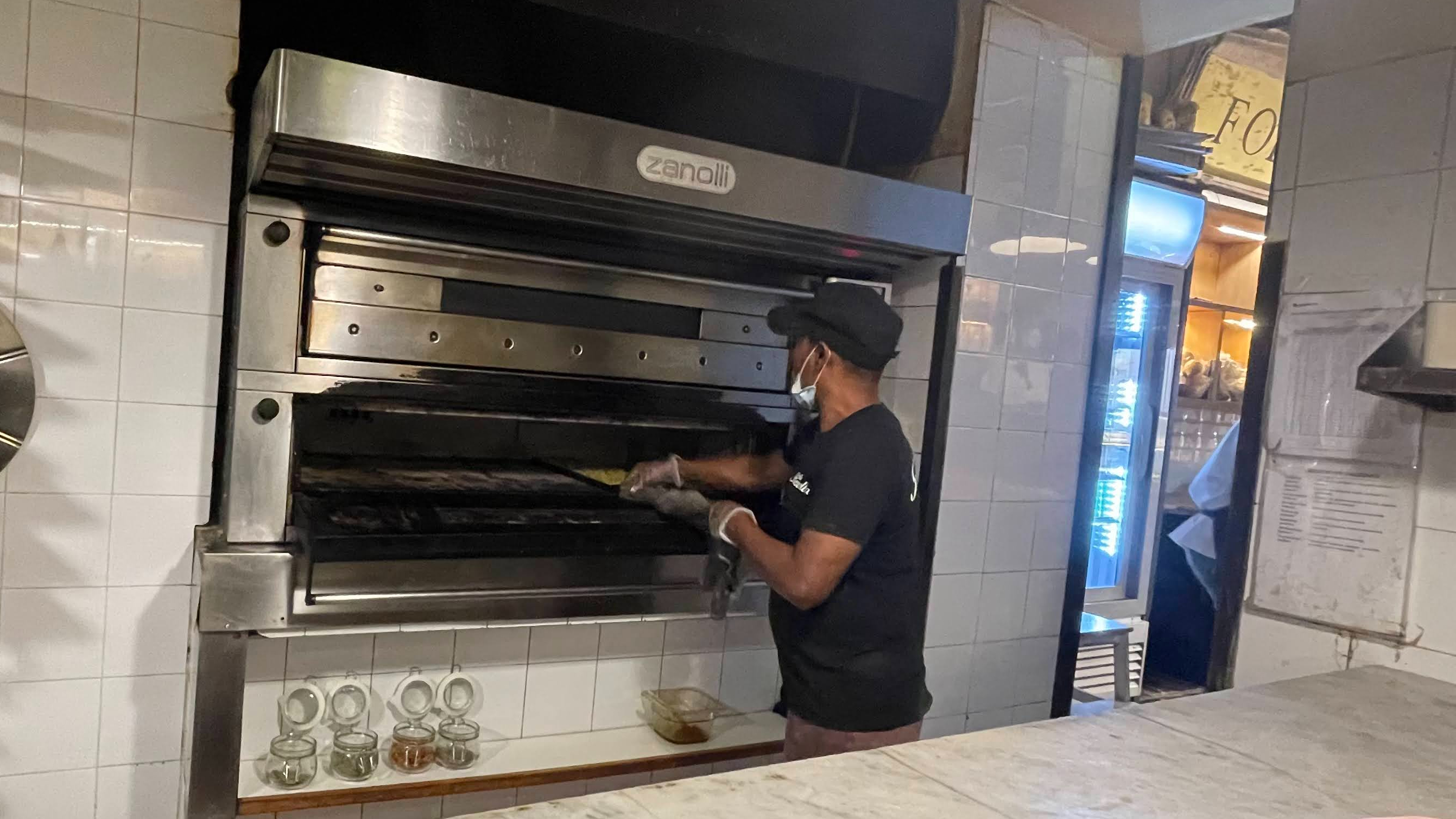
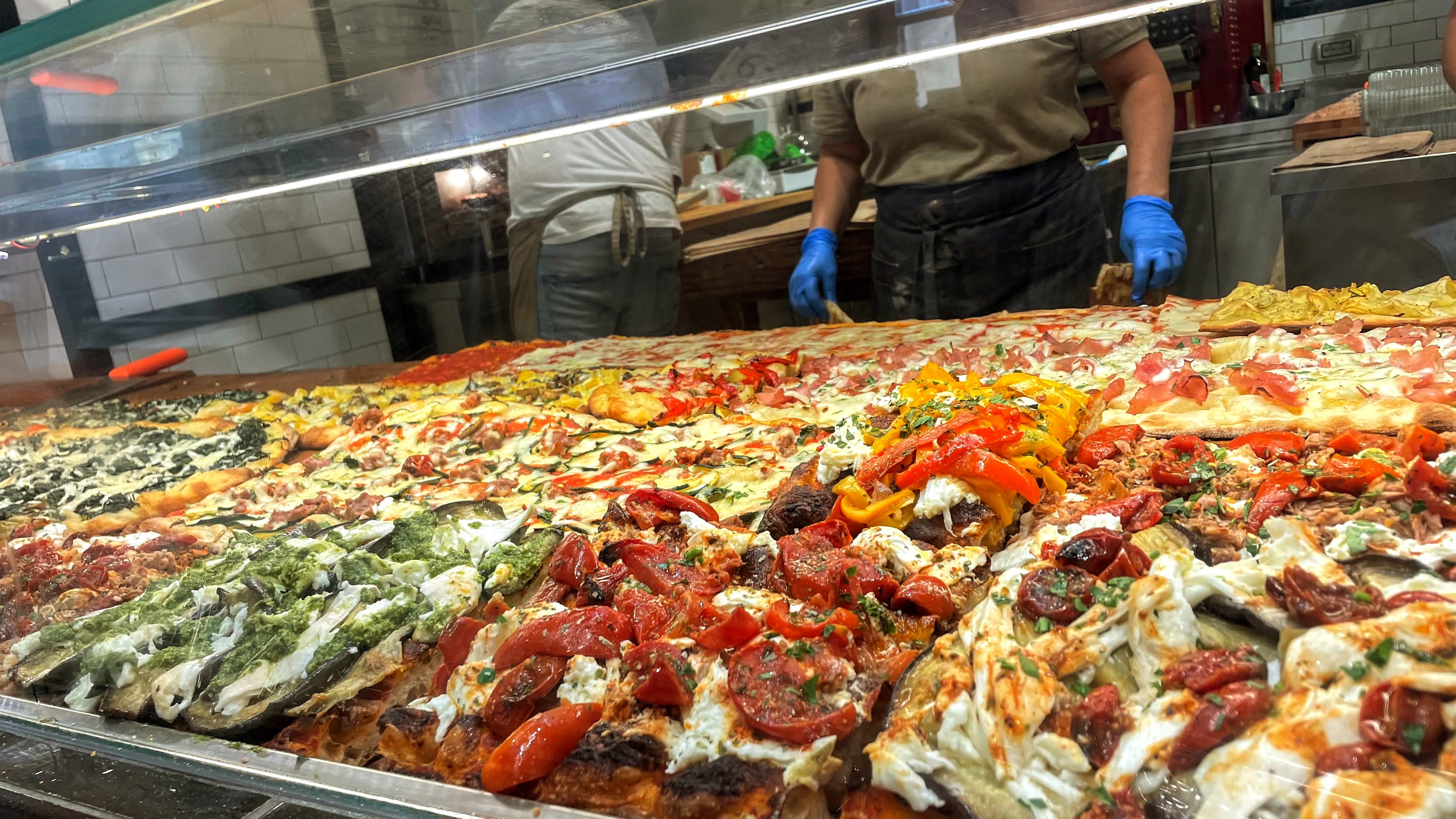
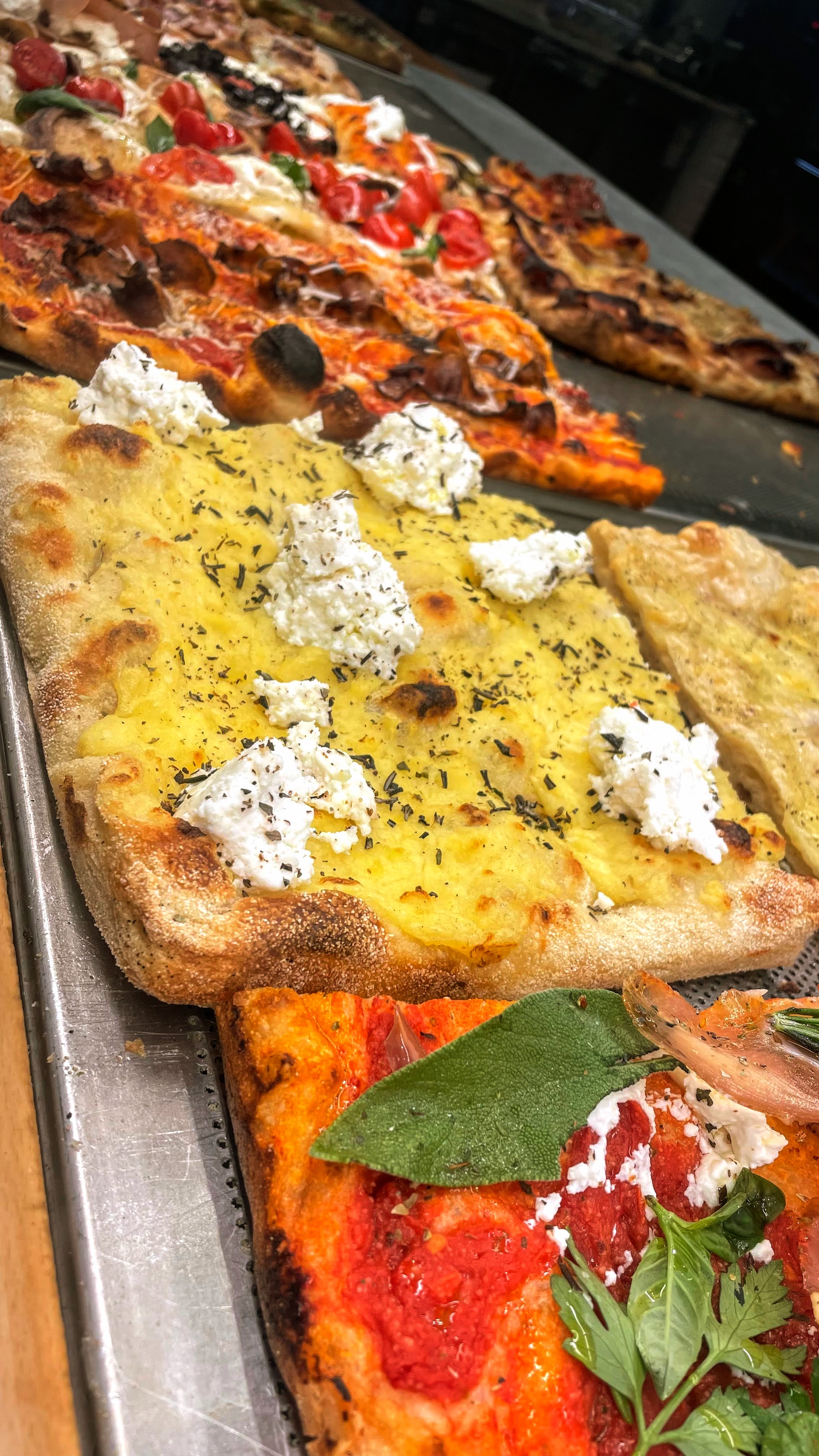
No wood-fired brick oven either – pizzas here continuously being made in steel pans (in teglia is “in a pan”), baked in gas fired steel ovens, then kept in glass counters waiting for customers. You walk up to the counter, take greedy, indecisive looks at a array of rectangular pizzas topped with all kinds of delcious combinations, and ask the server to cut off as much as you want of each kind . All combinations tend to be the same price – you pay by weight. You generally eat it room temperature or lightly reheated (which is a source of constant irritation to the Tripadvising American). The only constant is a distinct base of crisp bread about 2mm thick. The toppings – well, there are no standard toppings.
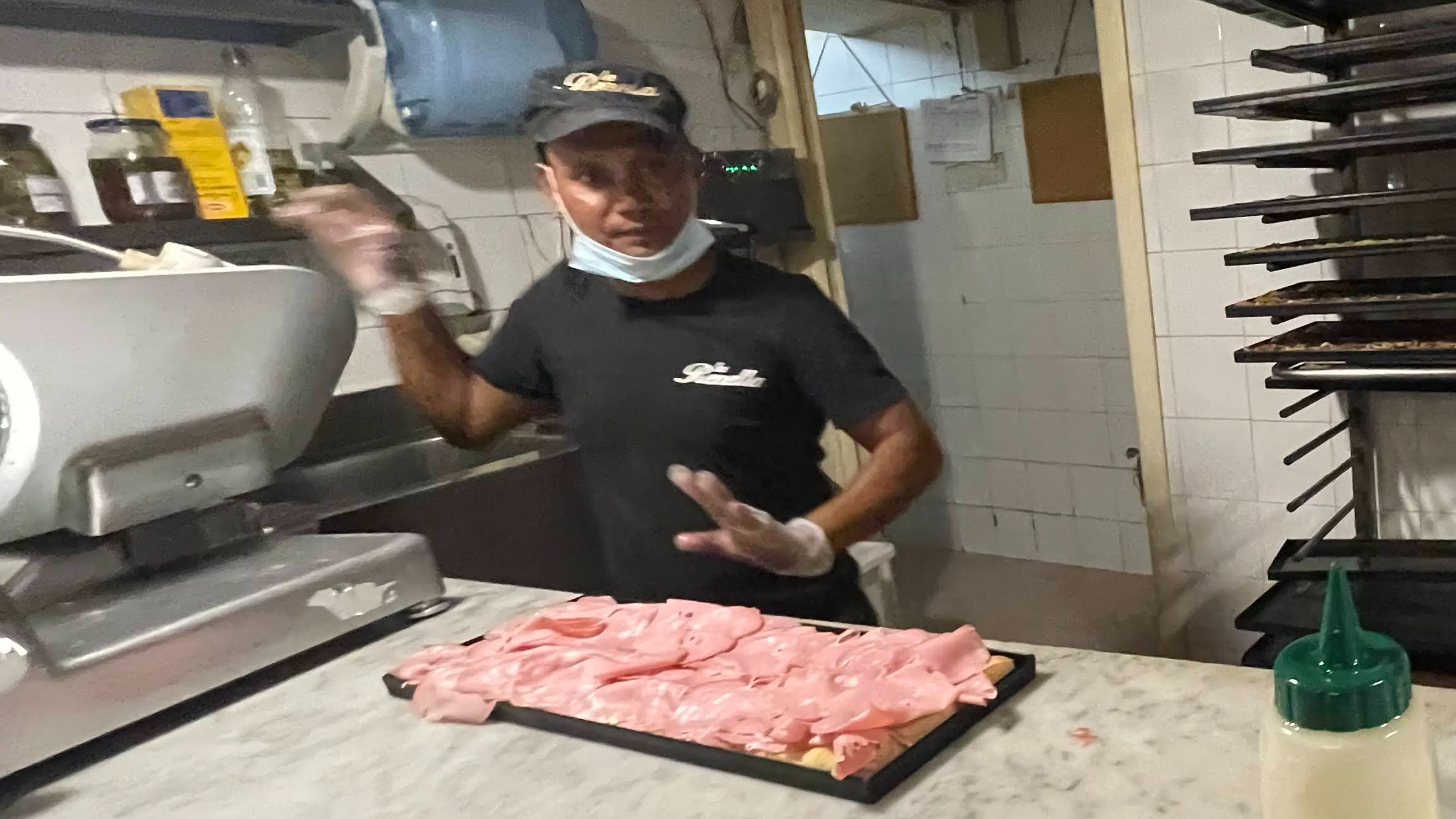
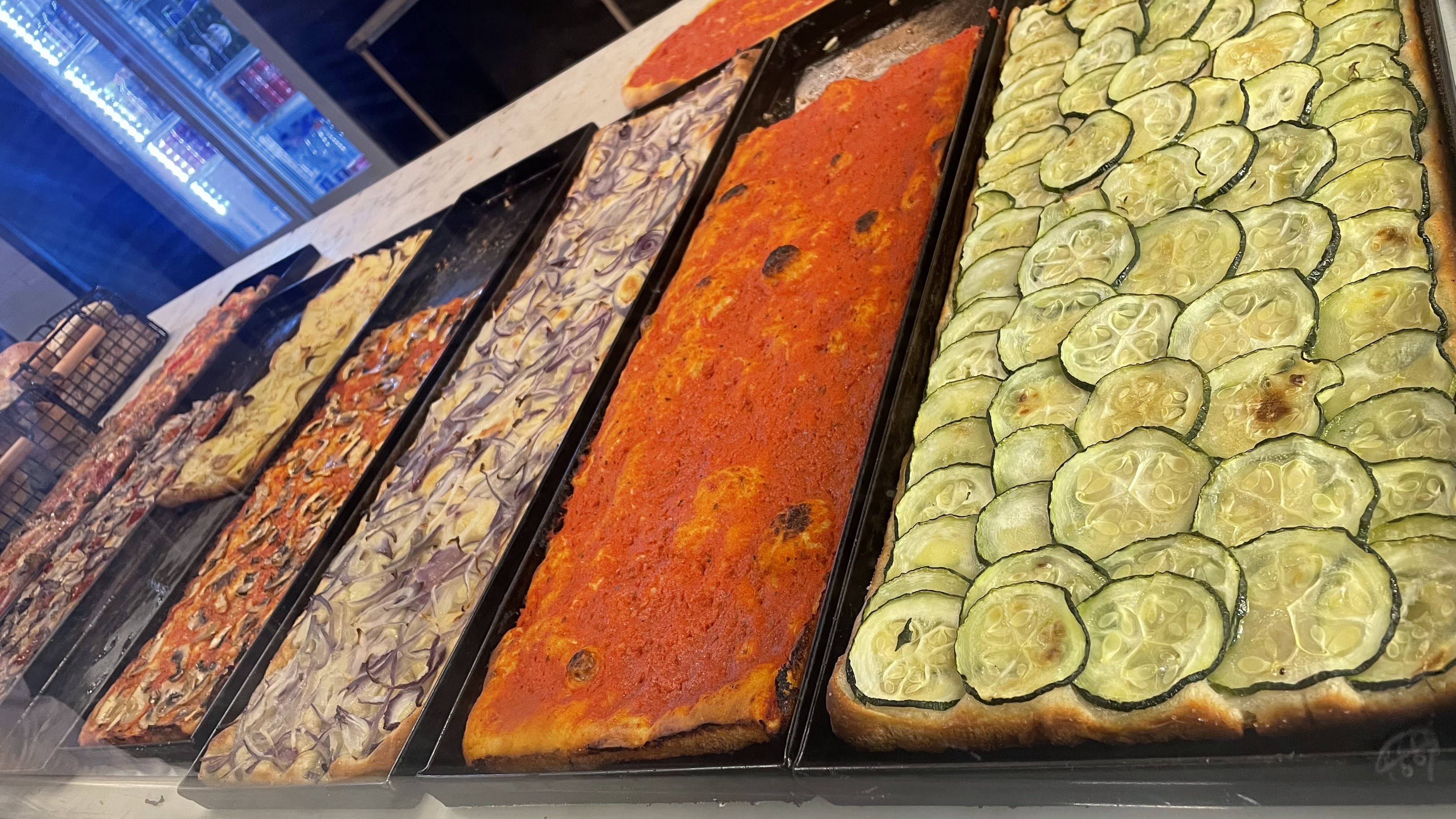
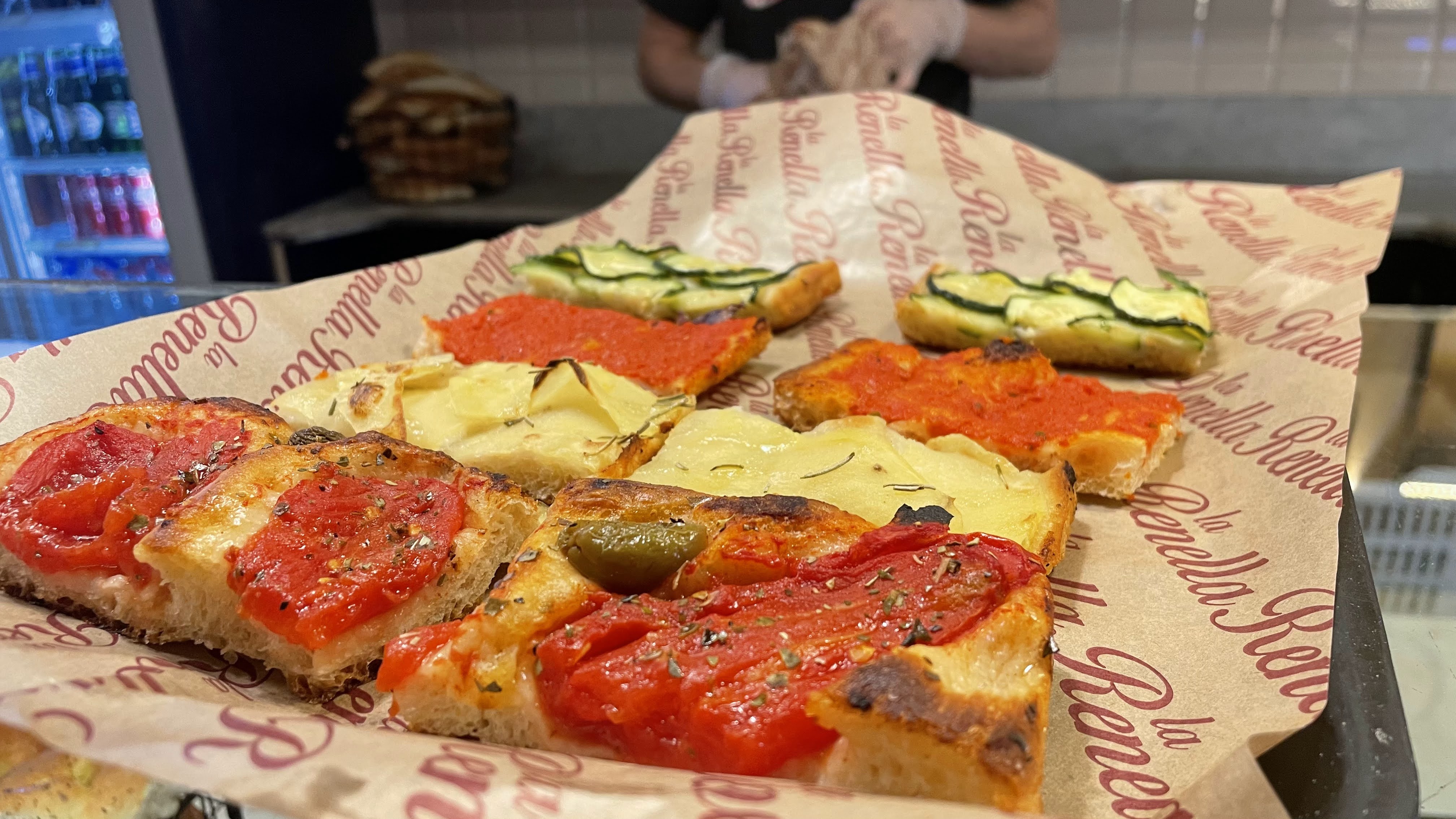
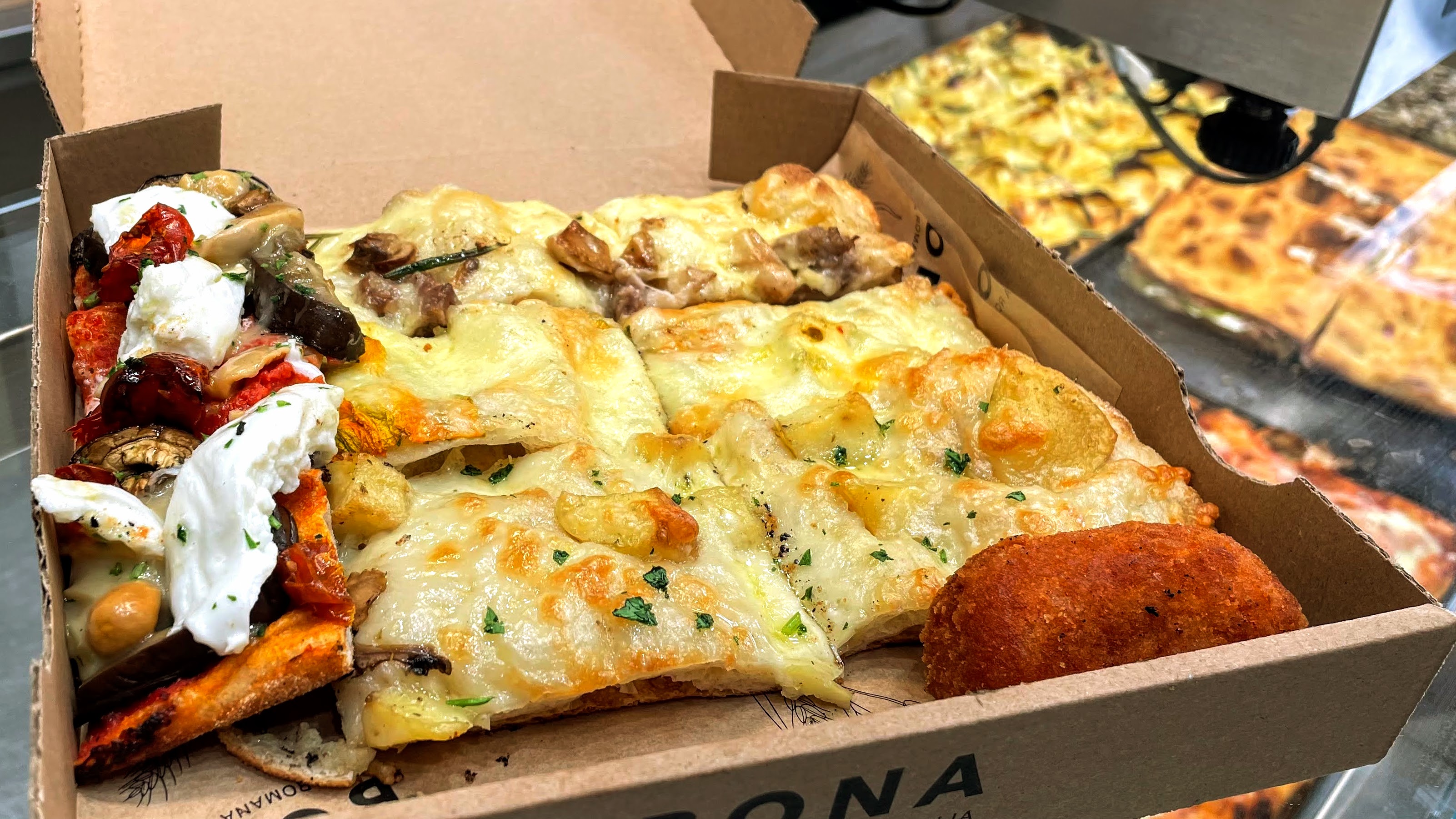
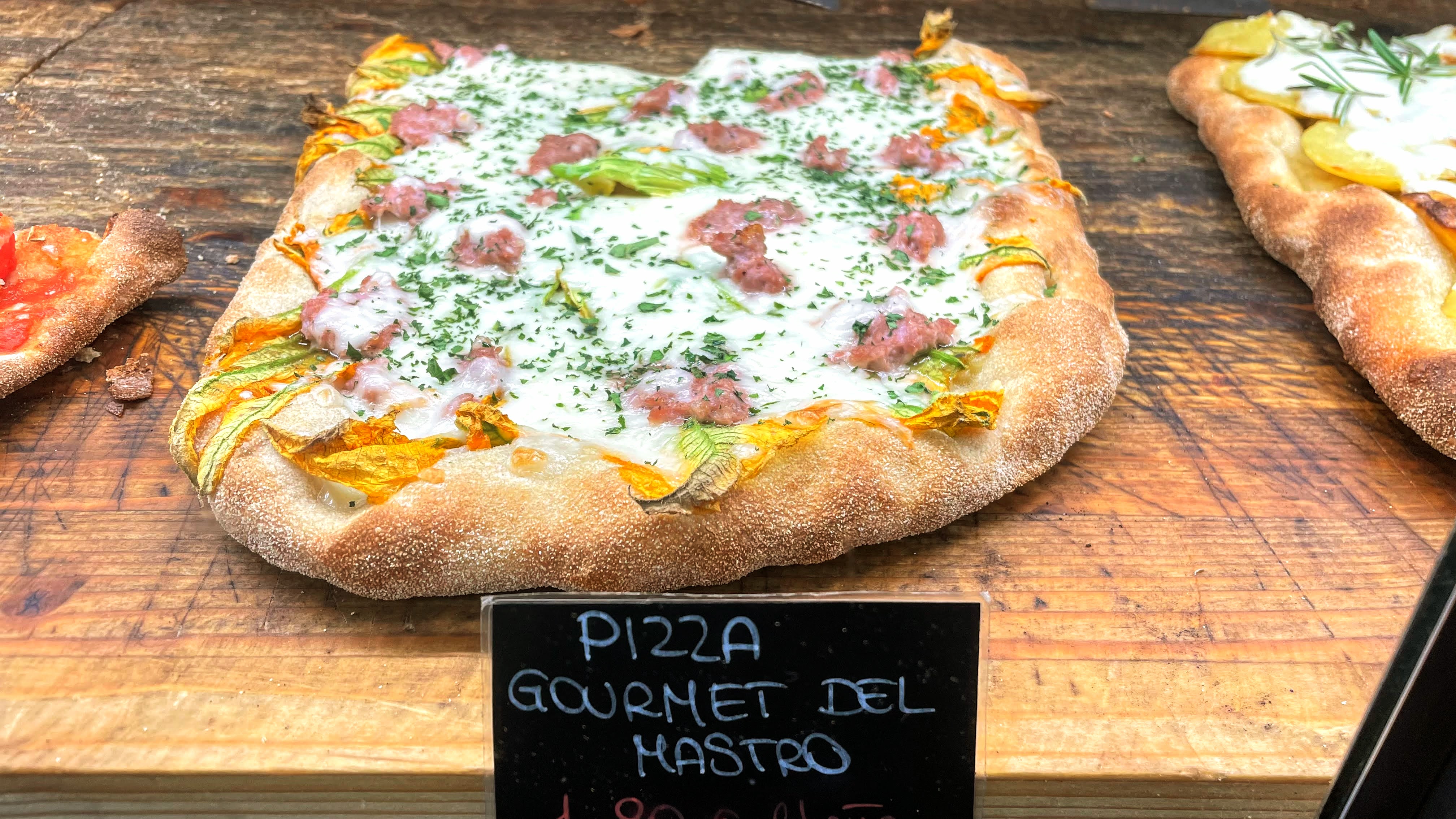
I soon realised that Roman pizza is really about those toppings; must be at least a hundred different combinations of meats, vegetables and cheeses in the city. Each outlet promotes its own as their signature so dining is an endless parade of difficult decisions. Many of these ingredients – eggplant, pumpkin, potato, zucchini flower, burrata; only in Rome can they be stars of their own pizzas. Counter staff also have different ways of slicing the pizzas; scissors, knives, pie rollers, cake slicers – I found that nearly as entertaining as the food. I tried persuading them into really thin slices, and soon realised they draw the line at about a two inch minimum (which restricted me to three-four variants per foray). They will then chop that piece into two pieces or so, for easy eating.
And no, pineapples are not to be seen.
One has to try quite hard to find a bad pizza in the city, so there are no real favourites; I could have – as the late Bourdain says – left my children for any one of the choices. La Renella in Travestere looks like a hidden find but had a thousand reviews (and even as I was sitting there, regular visits by tour parties). It offered excellent pizzzas, huge variety and a Bangladeshi chef who took me on a full tour of the ingredients. Then there was Mastro Donato, a much less discovered hole-in-the-wall (sporting a bicycle on that wall too) that had the most delicious pecorino, zucchini flower and salsiccia combination. These smaller joints, I realised, only have a few variants on the counter at any time so what you get depends on when you get there. There was a (smallish) pizza chain – Bona – conveniently around the corner whenever I felt peckish. Also in the circuit – the very crowded Antico Forno Roscioli, the bakery outlet of the Roscioli food empire not far from the Pantheon, offering a huge range of pizzas along with many other baked goodies. Finally,the trusty Mercato Centrale – attached to the main train station – has a very nice pizza counter among its many offerings.
And more…
Rome had other wonders as well, artichokes (especially fried), arancini-like rice balls called suppli, gelaterias sporting all kinds of flavours, coffee houses bustling with energy, espresso and arragostini and some very gourmet small bites all tucked away inside endless supplies of history.
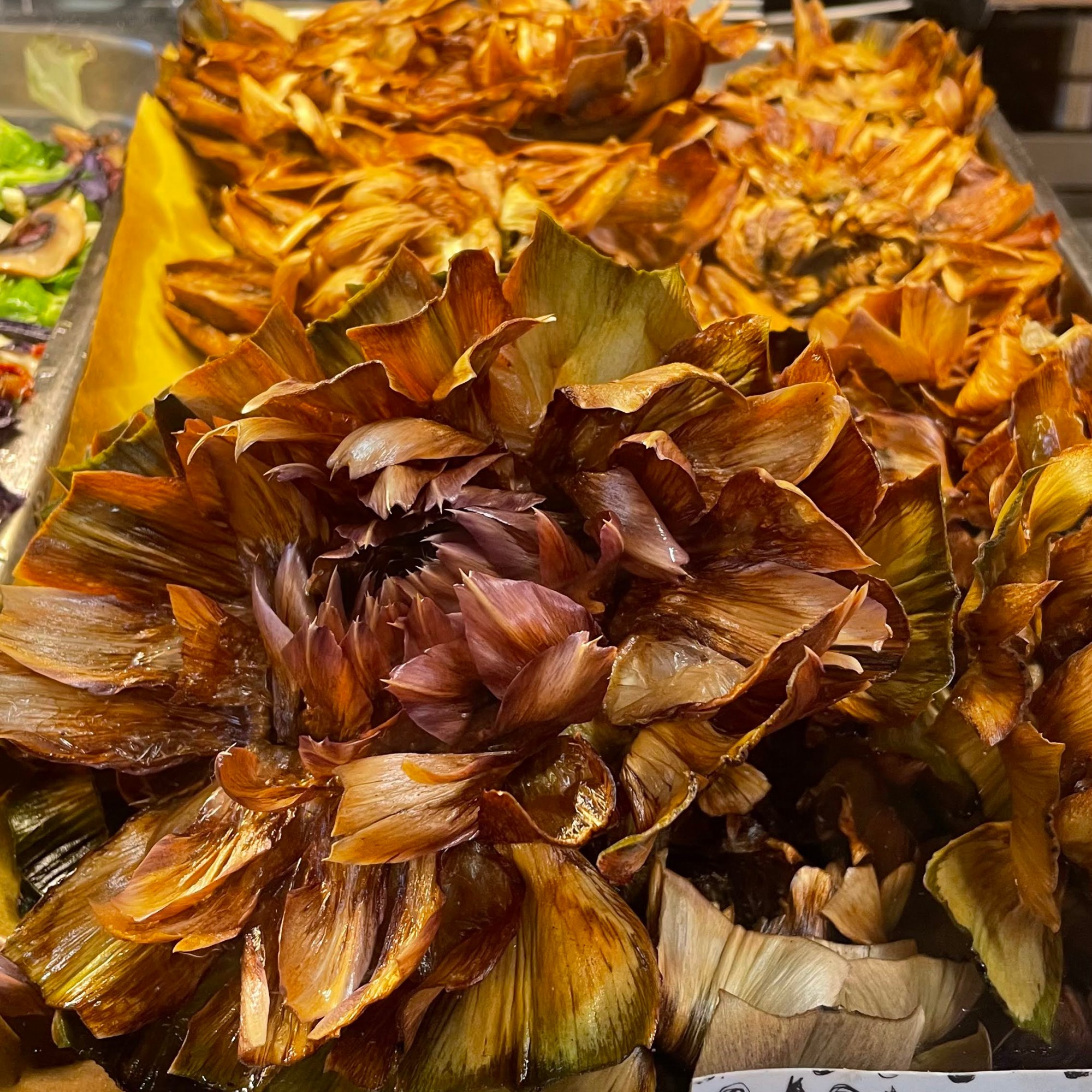
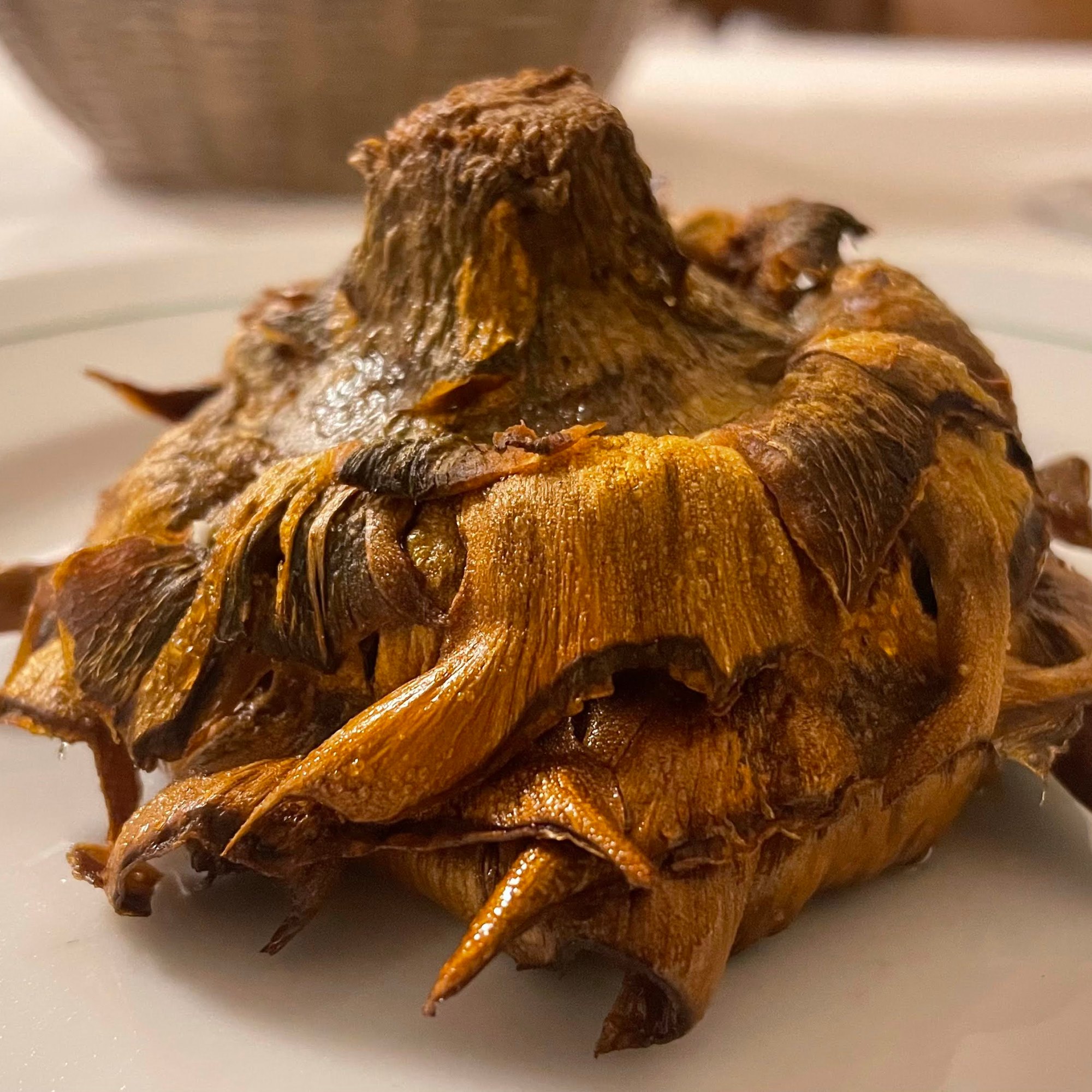
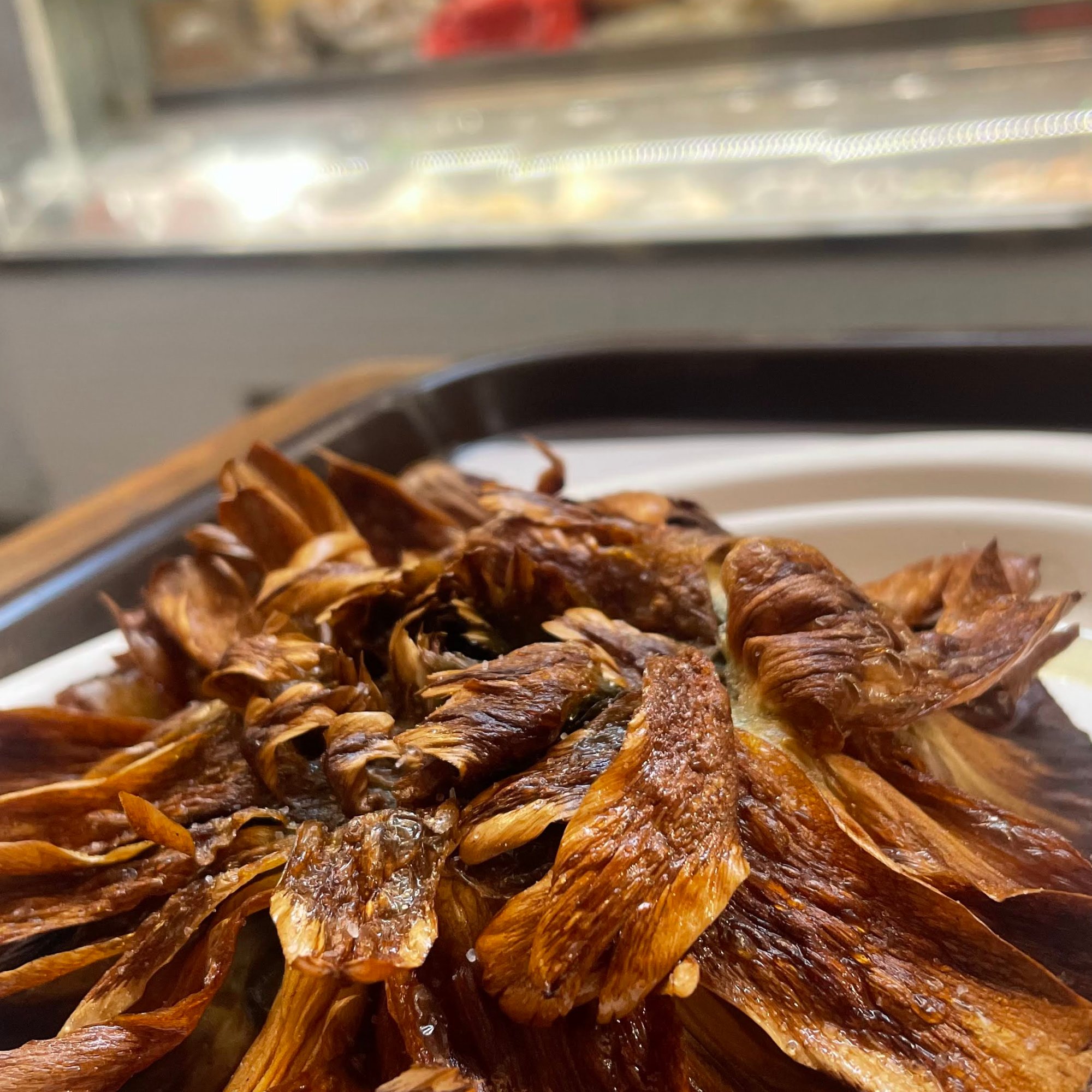
Of all this, the fried artichoke is particularly worthy of mention. While I’ve encountered the artichoke a few times before, its never been as common as on the streets of Rome and never in this way. Like so much Italian food, this is simply that – deep fried and nothing more – but addictively wonderful and hard to describe; suffice to say that I had more artichokes than ice creams in Rome.
Another dish I had only in Rome, and loved enough to repeat is apparently a Roman classic – saltimbocca. I hadn’t really heard about it; the first time I ordered it off a counter display at Mastro Donato I thought it was going to be fish (which is surprisingly hard to find in Rome) – imagine my surprise when a slice of proscuitto-wrapped veal jumped into the mouth from under all that butter sage sauce. Its a wonderful dish, so I tried it again in Trattoria Zampagna, with equally spectacular results. That’s what saltimbocca apparently means – jump in the mouth.
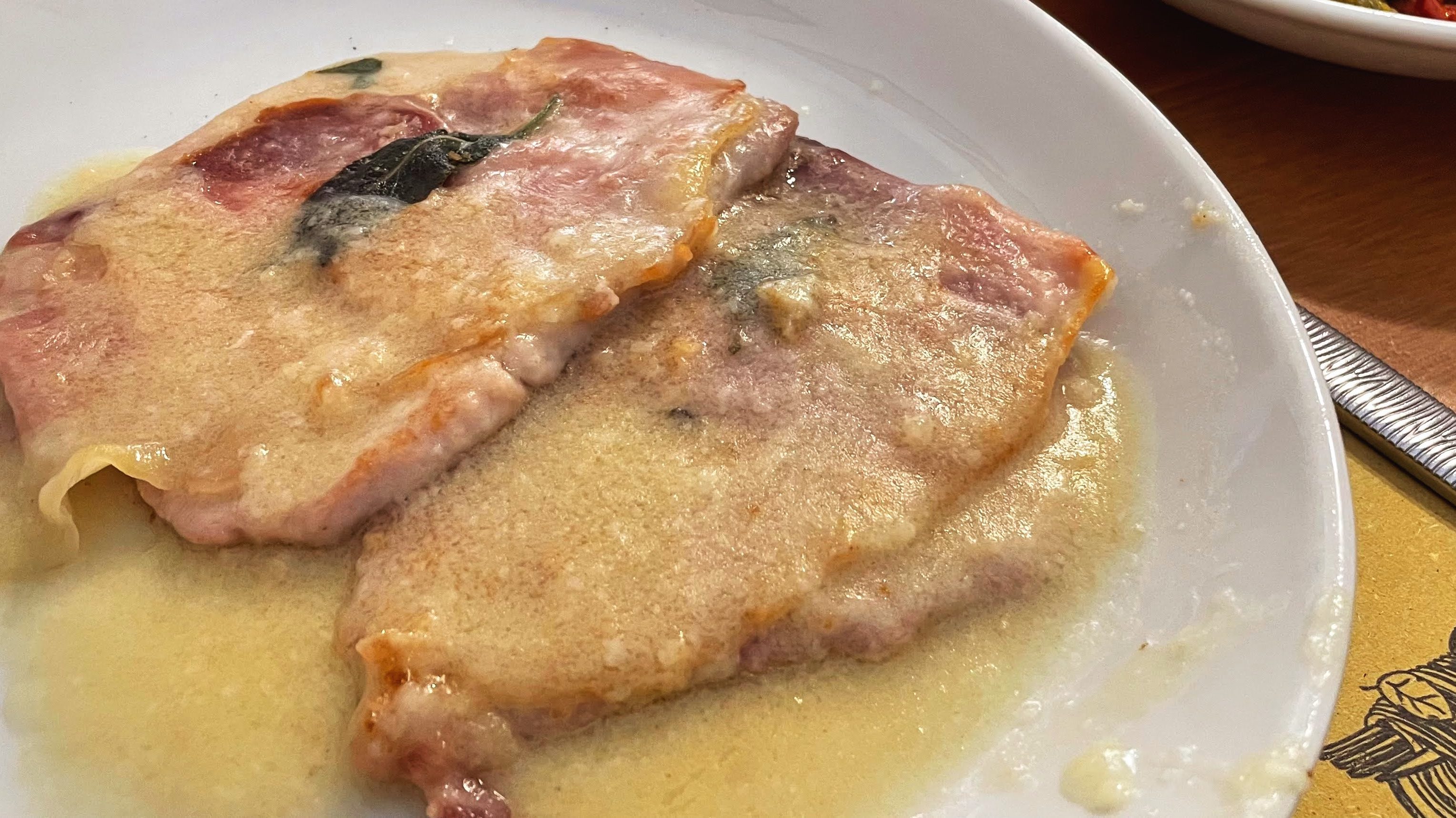
Artichokes and saltimbocca. Walk the path less trodden than pasta or pizza.
 The Well Fed Bong
Leave a comment